Drone Power Solutions (Flagship)
Nexfly 6S 17,000mAh (17Ah) Solid-State Drone Battery
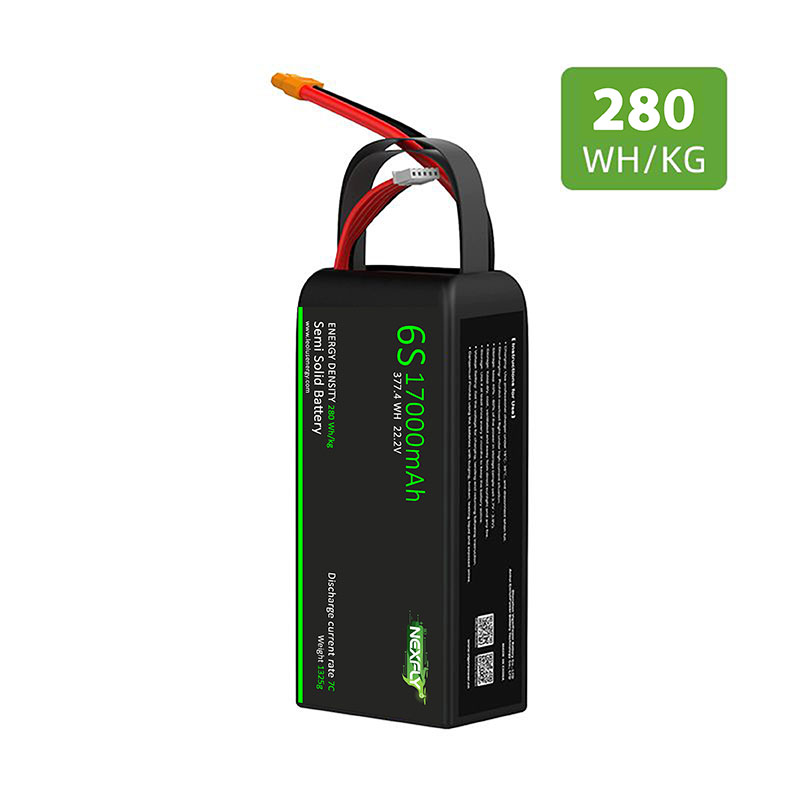
6S1P 17000mAh 22.2V
The Nexfly 6S1P 17,000mAh is a semi-solid state drone battery manufactured by Leolus Energy for professional UAV applications. Rated at 22.2V nominal voltage, this battery pack delivers high energy density, stable discharge performance, and advanced BMS protection for agriculture spraying, surveillance, mapping, and delivery drones.
- Battery Model: Nexfly 6S1P
- Nominal Capacity: 17000mAh
- Nominal Voltage: 22.2V
- Battery Dimensions: H:51.0±2.0mm W:74.0±1.0mm L:180.0±2.0mm
- Battery Weight: ~1570g
- Cell Energy Density: ≥235WH
- Cycle Life: ≥600cycle
- Peak Discharge: 10C
Key Features -
Clean Energy with Smarter Innovation

Engineered with high-density lithium cells, our batteries provide extended lifecycle performance, ensuring years of dependable energy storage with minimal degradation.
Every Nexfly 6S pack ships with an integrated battery management system that monitors each of its 6 cells individually at ±5mV resolution, balances them (active and passive balancing), and cuts off on overcharge, over-discharge and short circuit — the short-circuit switch is MOSFET-based and responds in under a millisecond. Temperature is watched at multiple points in the pack, and fault events are logged, so a pack that has been abused shows it instead of hiding it. More on why this matters: BMS and drone battery safety.
Semi-solid state packs need no watering, venting or periodic equalising. Day-to-day care comes down to three habits: charge with a balance charger at the rate on the pack’s datasheet, let the pack cool below 35°C before charging, and store it at 50–60% charge if it will rest for more than 48 hours. At end of life, contact our Bangalore facility about return and collection for bulk quantities — see lithium battery recycling.
This pack is rated for 10C peak discharge — roughly 170A from its 17Ah capacity. Headroom like this suits airframes whose motors pull hard on take-off, climb-out and in gusty conditions. Charging time depends on your charger and the charge rate on the datasheet; our drone battery charger guide explains how to match the two.
The BMS supplies the state-of-charge and cell data behind your low-battery warning and return-to-home trigger. If your platform expects a specific smart-battery telemetry link to the flight controller (for example over UART or I2C), tell us the protocol when you request a quote — matching existing telemetry is part of our custom battery work for OEMs.
Semi-solid state chemistry stores more energy per gram than conventional LiPo — up to ~338 Wh/kg at pack level across the Nexfly range, against roughly 150–200 Wh/kg for standard LiPo — so the aircraft carries less battery for the same flight time. The energy density calculated for this specific pack is shown in the table below.
Others Drone Batteries
Semi-Solid
Semi-Solid
Semi-Solid
Semi-Solid
Semi-Solid
Semi-Solid
Semi-Solid
Let's Connect -
Powering Your Vision With Smarter Energy.
Have a project in mind or need a custom battery solution?
Our Brands


What this pack actually delivers
| Nominal voltage | 22.2V — 6S (22.2V) |
|---|---|
| Capacity | 17,000mAh (17Ah) |
| Stored energy | 377 Wh — voltage × capacity, the number that actually decides flight time |
| Pack weight | approx. 1,400g |
| Energy density | 270 Wh/kg — computed for this pack, not a best-case figure from elsewhere in the range |
A mid-capacity pack, and usually the best endurance-per-gram compromise on a given airframe. Most operators who start at the top of the range end up here once they have weighed the aircraft with a full payload.
What it suits
the working middle of Indian commercial UAV operations — agriculture spraying at 10–16L, mapping and survey platforms, delivery and surveillance airframes flying real duty cycles daily.
What it is not for
the heaviest spraying rigs and long-endurance BVLOS work, where 12S will hold voltage better under sustained load and leave more headroom at the end of the flight.
Before you order
This is the most common configuration we ship. If you are choosing between 6S and 12S, the deciding factor is usually all-up weight and how long you need to stay in the air, not capacity.
Send us your airframe, all-up weight with payload, and the flight time you need. A pack that is right on paper and wrong on the aircraft helps nobody, and we would rather tell you a smaller pack is the better fit than sell you the largest one in the range.
Customer reviews
No reviews for this pack yet. If you have flown it, tell other operators how it held up — flight time, how it behaved in heat, how many cycles you have on it.
Write a review
Reviews are moderated before publishing. We do not edit them for tone — a three-star review that explains itself is more useful to the next buyer than a five-star one that does not.